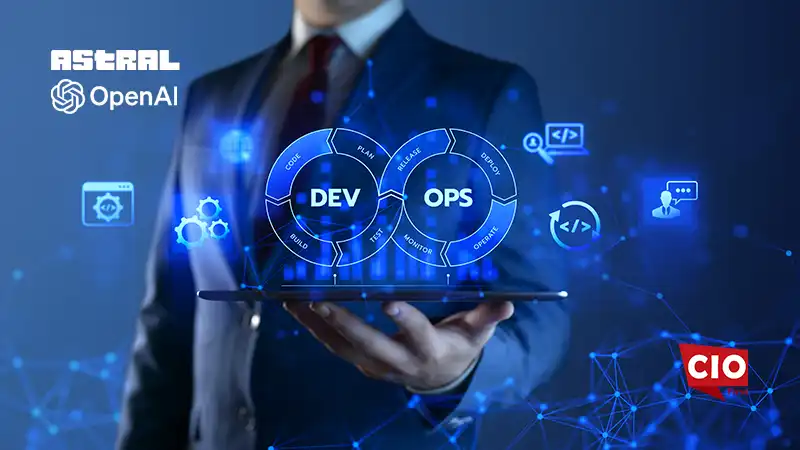
OpenAI disclosed its acquisition plans for Astral, the leading maker of developer tools, with a view to boosting its ecosystem of AI coding and augmenting the features of its Codex platform. Announced in March 2026, this deal makes Atral’s popular open-source developer tools accessible to OpenAI’s vaster collection of AI-powered software engineering solutions.
Astral specializes in creating a new generation of Python developer tools – dependency managers, linters, and type checkersthat go deep into the workflows of developers today. Now integrated into OpenAI’s Codex, these tools will allow AI to not only generate code but also manage the whole software lifecycle, including planning debugging testing, and maintenance.
Expanding AI’s Role in Software Development
The acquisition is an extension of OpenAI’s overall strategy for building out Codex as a full-stack AI software engineering agent. Instead of just offering code snippets for developers, the tool is intended to play an active role in the development process, working with tools and altering codebases while verifying results on its own.
The tools provided by Astral are especially important as they are already integrated at the core of the developer environments for speed, reliability, and efficiency. By integrating these tools with Codex, OpenAI is placing artificial intelligence at the core of the software development process.
This change is also driven by the increasing competition in AI coding platforms, where others are providing advanced tools for AI coders. The acquisition would enable OpenAI to remain competitive while becoming more grounded in reality.
Why This Matters for Cybersecurity
Though the announcement is largely focused on the development of AI, it has substantial implications for the Cybersecurity industry.
While the use of AI technology becomes integral to the development of software applications, it becomes imperative for the security of the applications. The security of the applications must be ensured.
The integration of Astral’s tools into Codex can improve cybersecurity in several ways:
1. Automated Secure Coding
AI technologies have the ability to monitor adherence to coding standards, locate security loopholes, and integrate the most effective security measures in the coding phase.
Also Read: Samsung and AMD Expand Partnership on Next-Gen AI Memory Solutions
2. Continuous Security Validation
Thanks to built-in capabilities for testing and validation, AI is capable of spotting problems like unsafe dependencies, incorrect configurations, or logical errors even before the launch of the application.
3. Reduced Human Error
Because manual coding mistakes are a source of many cybersecurity vulnerabilities, allowing AI-driven automation to take over some tasks can cut off these risks by making the development procedures more uniform.
The Rise of AI-Driven Secure Development
The acquisition is in line with the broader industry move towards DevSecOps, which refers to the integration of security into the development lifecycle rather than an afterthought.
Through the use of AI and developer tools, OpenAI is helping to bring about “secure by design” systems, which include:
Automated and continuous security checks
Vulnerability detection at early stages of the development lifecycle
Compliance requirements integrated into the development lifecycle
This is significant as organizations are beginning to use AI-generated code at scale, which can bring new risks.
Business Implications for the Industry
The OpenAI-Astral partnership is likely to influence in several ways the businesses that operate in cybersecurity and software development.
With AI-assisted programming tools that come with security built-in, companies will be able to develop applications that are easier to secure.
Since automation can handle tasks such as coding, testing and security validation, companies are able to have new product roll-outs faster than before.
Identifying security loopholes at an early stage enables organizations to save on expenses related to patching up security issues at a later stage in the development.
In order to develop as well as secure their code, companies are going to be relying more and more on AI ecosystems such as Codex.
This will cause a reshuffle of the competitive landscape.
Expanding the Cybersecurity Attack Surface
While the potential advantages are considerable, the acquisition also poses new challenges for cybersecurity.
As AI plays a larger role in coding and managing systems, attackers may seek to:
Exploit vulnerabilities in AI-generated code
Manipulate AI development tools through malicious inputs
Target integrated toolchains and APIs
This creates a need for AI-specific cybersecurity frameworks, including:
Model security and validation
Secure toolchain integration
Protection against prompt injection and data poisoning
A Strategic Move Towards AI-First Security
The acquisition of Astral is a part of OpenAI’s broader effort to make AI adoption in the enterprise environment a reality, where security, reliability, and scalability are of utmost importance.
By incorporating development tooling into AI systems themselves, OpenAI is paving the path towards a future where AI doesn’t just write the software but can protect it as well. This marks a significant shift from the conventional approach to cybersecurity.
Conclusion
Almost like one-piece puzzle, OpenAI was able to acquire Astral, and this can be considered a significant milestone in the development of AI-driven software engineering. On its Codex platform, the company is inserting elite software development tools which result in new smart systems that are capable of running the whole software lifecycle without human intervention.
The effect of the stuff on a cybersecurity industry is so deep that to some that make sense. Since AI is turning into a heart of developer’s workflows, security also needs to be developed by migrating it to automated, integrated, and AI-driven approaches.
For those who are in business, the message is totally understandable: the destiny of software development and cybersecurity is getting on the same track, and those organizations that will welcome AI-powered, secure development practices will be given better chances to continue innovating, and even to compete, in an increasingly digital world.