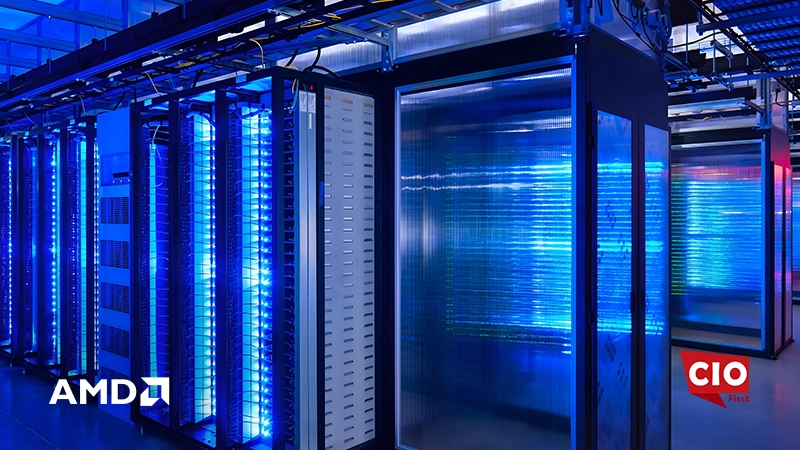
AMD, a leader in high-performance and AI computing, and Tata Consultancy Services (TCS), a global technology services firm, announced an expanded strategic collaboration to bring AMD’s Helios rack-scale AI architecture to India. The initiative aims to support the country’s national AI initiatives and build a blueprint for AI-ready data centers capable of supporting up to 200 MW of compute capacity.
Under the partnership – executed through TCS’s subsidiary HyperVault AI Data Center Limited – the two companies will co-develop a rack-scale infrastructure design powered by AMD technology targeting sovereign AI factories, hyperscalers, and large enterprise deployments. This effort brings AMD’s cutting-edge hardware stack to Indian data center build-outs and sets the stage for large-scale AI training and inference computing within the country.
What Helios Is – and Why It Matters for Data Centers
The Helios rack-scale AI platform is AMD’s open, modular architecture designed specifically to support gigawatt-scale AI infrastructure. Typical data center configurations are based on generic server racks that scale CPUs and memory but are not optimized for the extraordinary compute density, bandwidth, and power demands of generative AI model training and inference. Helios, by contrast, integrates high-performance components – including AMD Instinct™ MI455X GPUs, next-generation AMD EPYC™ “Venice” CPUs, and AMD Pensando™ Vulcano network interface cards – into a purpose-built rack optimized for AI workloads with high efficiency and performance at scale.
The open nature of Helios — aligned with industry-wide standards such as open rack specifications – gives data center architects a flexible, vendor-agnostic platform that supports evolving AI demand without lock-in. This capability will be crucial as enterprises transition from pilot AI deployments to full production workloads that extend across cloud, edge, and sovereign compute infrastructure.
This paradigm shift is at the heart of the evolution of modern Data Center architecture, where conventional CPU-centric workloads are being replaced by AI-specific compute fabrics that require dense accelerators, high-bandwidth interconnects, and scalable cooling solutions. (For more information on the evolution of data centers to support AI and cloud computing, see Data Center and the industry below.)
Implications for India’s Data Center Landscape
1. Supporting AI at National and Enterprise Scale
India has identified AI as one of its strategic areas of focus for economic development and technological independence, particularly through initiatives that promote sovereign AI computing infrastructure, which is owned and controlled in the country. The Helios project directly relates to this vision by providing a roadmap for data centers that can handle the most demanding AI workloads without relying on foreign cloud infrastructure.
The 200 MW capacity plan goes beyond the current servers or small-scale clusters to gigawatt-scale facilities that can accommodate multiple Helios AI racks, which is critical for training large language models, simulations, and analytics. Such infrastructure also encourages the involvement of hyperscalers, AI innovators, and large enterprises who want to establish AI infrastructure in Indian data centers.
By aligning with the Indian IT ecosystem expertise through TCS, AMD is making this transition more accessible and affordable, as TCS has extensive experience in integration, deployment, and operations in hybrid environments.
Also Read: Cognizant Expands Google Cloud Partnership for Enterprise AI
2. Accelerating Data Center Build-Outs
The partnership also involves collaboration with hyperscalers and AI-native firms to accelerate the development of data centers in India. This will make it easier for companies to implement AI, as the architecture will be pre-integrated and can be implemented faster compared to custom-built architectures.
This will create a ripple effect in the infrastructure supply chain, including networking, cooling, and storage integrators, since data centers that handle Helios-type workloads require sophisticated power distribution, cooling, and high-density networking solutions.
Broader Effects on the Data Center Industry
Boosting Local Cloud and AI Ecosystems
The Helios initiative enhances the local cloud and AI ecosystem by allowing enterprises to process high-performance workloads locally. Although hyperscalers have long been the norm in AI infrastructure through the use of cloud regions, local data centers with Helios architecture enable enterprises to maintain their sensitive data, customized models, and mission-critical workflows in sovereign infrastructure, which has become a priority for regulated industries such as financial services, healthcare, and government. (See Data Center for industry context).
Competition and Market Dynamics
Through the development of rack-scale AI infrastructure in India, AMD and TCS are positioning themselves as major contenders in the market against other international companies that offer AI data center solutions, including NVIDIA or hyperscale clouds. This may result in more competitive pricing and innovation in workload-optimized hardware.
The emphasis on open architecture is also a departure from proprietary solutions, which allow companies to integrate components from different vendors, a trend that is becoming more attractive due to the complexity of data centers.
Driving Operational Efficiency and Sustainability
AI workloads have been known to be extremely power-hungry. The fact that Helios’s strategy is centered on compute, networking, and cooling integration in a power-efficient way helps significantly in preventing power waste and ensuring maximum data throughput. This is particularly important for enterprises that aim to achieve a balance between performance and sustainability goals, especially in the wake of increasing energy costs and environmental regulations.
Impact on Businesses Operating in the Data Center Sector
For data center operators, this collaboration presents new business opportunities to develop and rent AI-ready facilities. Data center operators who provide wholesale or colocation data center services can adopt Helios architecture to attract AI-centric clients, such as AI startups, tech companies, and cloud service providers.
Cloud service providers and managed service businesses will also see opportunities in providing Helios-based infrastructure services ranging from AI training compute clusters to hybrid cloud solutions that combine on-premises Helios installations with larger public cloud environments.
Large-scale AI initiatives in enterprises will now enjoy lower deployment risk, faster time-to-insight, and access to a scalable compute architecture that has been proven and is industry-backed by two major industry leaders. This is an area that has been a bottleneck in the past for the transition of pilot AI implementations to production-grade AI infrastructure, and Helios helps fill this gap.
Conclusion
The AMD-TCS Helios initiative is a major step ahead in harmonizing high-performance computing for AI with the capabilities of data centers. The collaboration between AMD’s expertise in compute technology and TCS’s system integration capabilities not only helps to realize the country’s AI vision, but it also marks the beginning of a new era for data centers, which will be shaped by the growing requirements of AI workloads.
This collaboration illustrates that the future of Data Center infrastructure will be based on open, scalable, purpose-built solutions that provide performance and flexibility, and this trend will continue to influence cloud and enterprise computing well into the next decade.