
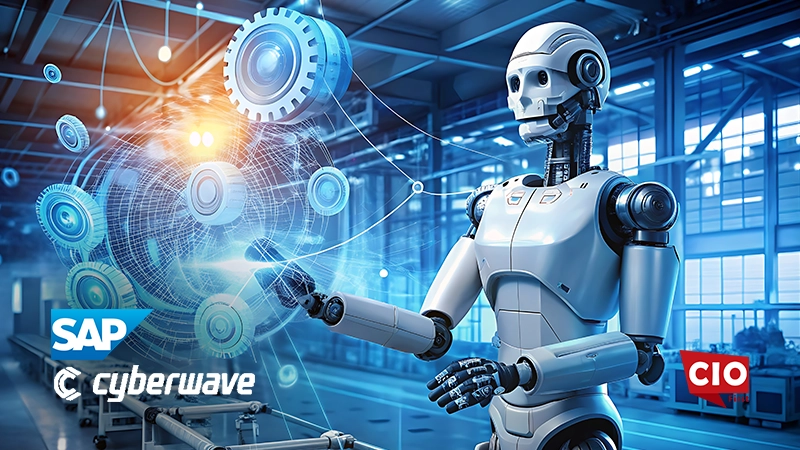
While in the realm of enterprise technologies, “AI” has until now only existed within the digital domain, making decisions for spreadsheets, predicting demands, and generating e-mails. But that distinction will soon be a thing of the past. For on May 11, 2026, SAP SE, the leader in business software applications, has made history alongside AI robotics innovator Cyberwave, with their unveiling of the world’s first AI robot deployed in an SAP logistics warehouse in St. Leon-Rot, Germany.
This launch represents the first major step toward implementing SAP’s Physical AI initiative. By moving from test units to real-world warehouses, SAP and Cyberwave have demonstrated that the next generation of robots is not simply programmable; it is adaptable.
Robots From “Rigid” to “Reasoning”
Classic warehouse robots have been derided for years due to their rigidness. While these robots were programmed to execute repetitive actions in static conditions, they struggled to handle the unpredictable nature of modern logistics centers, which include box size variations, lighting differences, and co-workers around the workplace.
However, the partnership between SAP and Cyberwave is altering the narrative with Vision-Language-Action (VLA) models and Reinforcement Learning (RL).
Some of the technical achievements of the partnership include:
Fast Training: As opposed to classic models that take months to code one specific robot command, Cyberwave’s technology enables any person to train robots with basic demonstrations. In this case, training times drop from weeks to hours.
Unified Process Flow: The robots are linked to the SAP Logistics Management (LGM) software through the SAP Business Technology Platform (BTP), which guarantees that each action from the robots, such as folding boxes and applying labels, matches up to the information stored in the digital “single source of truth.”
Fulfillment on Its Own: In the St. Leon-Rot warehouse, the robots are completing full cycles of activities, such as folding boxes, packing items, and preparing them for delivery inside the facility.
Impact on the Robotic Process Automation (RPA) Industry
For the Robotic Process Automation (RPA) sector, this news signals a “generational pivot.” We are moving beyond the era of Digital RPA (software bots clicking through menus) and into the era of Embodied RPA (physical bots navigating 3D spaces).
Also Read: Cognizant Unveils Secure AI Services to Scale Agentic Systems
1. The Convergence of Digital and Physical Bots
Historically, RPA focused on automating administrative tasks. The SAP-Cyberwave integration suggests a future where a single automated “mission” could span both worlds. For example, an RPA bot could detect a stock shortage in an ERP system and immediately trigger a physical robot in the warehouse to move a pallet-all without human intervention. This creates a “unified automation fabric” across the enterprise.
2. Move Towards “Zero-Code” Robotics
The ease of training these robots poses a direct challenge to conventional robotics companies. By embracing the “no-code/low-code” principle used in business software applications, Cyberwave is rendering the physical world just as programmable as a website. This move reduces the difficulty faced by medium-sized firms that otherwise would have found it difficult to cope with the engineering burden associated with traditional automation.
3. Increasing Workforce Resilience
With continued labor shortage problems plaguing the international logistics industry, it makes sense for companies to embrace “Agentic Robots” in order to safeguard against such situations. With these robots, companies are able to cover up “surge” times and even perform difficult shifts, enabling the human workforce to take on more valuable roles.
Effects on Businesses Operating in the Industry
For companies navigating the supply chain and manufacturing landscape, the implications are profound:
Lower Total Cost of Ownership (TCO): Because these robots are hardware-agnostic (using Cyberwave’s abstraction layer), businesses are no longer locked into a single robot manufacturer. They can mix and match hardware from different vendors while maintaining a single, consistent management platform through SAP.
Operational Scalability: The ability to “train once and deploy everywhere” means that a successful robotic mission developed in one plant can be instantly pushed to a hundred other facilities globally via the cloud. This provides a level of standardized performance that was previously impossible.
Safety and Compliance: SAP BTP provides the governance layer for these physical actions. Every movement is logged, and “kill switches” or safety envelopes are managed through centralized policies, ensuring that autonomous robots comply with strict international safety standards.
Throughput Optimization: Real-world data from the St. Leon-Rot deployment suggests that integrating physical AI directly into the LGM backbone can lead to significant increases in warehouse throughput, as robots can adjust their speed and paths based on real-time order priority data.
Conclusion
The partnership between SAP and Cyberwave is a landmark moment that confirms the arrival of the “Autonomous Enterprise.” By successfully embedding AI-driven robots into a live, high-variability warehouse, they have moved the conversation from “if” robots can handle the physical world to “how quickly” they will be deployed. For businesses in 2026, the choice is clear: embrace the transition to Physical AI or risk being tethered to the slow, manual processes of the past.