

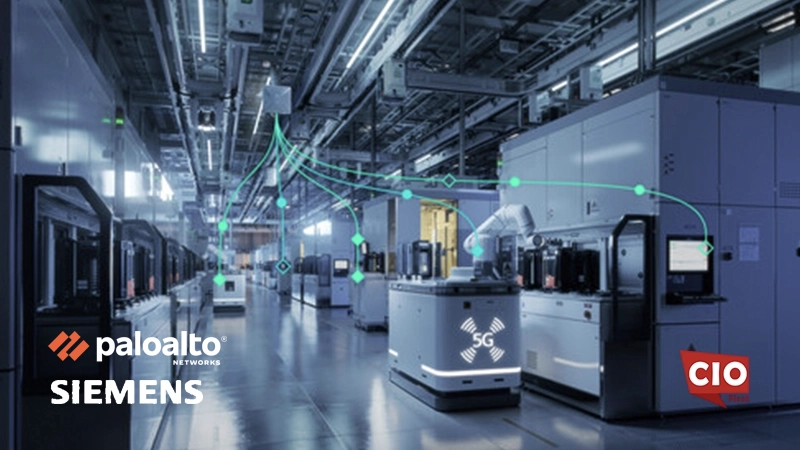
Siemens and Palo Alto Networks announced a validated AI-driven cybersecurity solution for industrial private 5G networks, announced during Mobile World Congress 2026. This innovative solution brings together Siemens’ industrial-grade private 5G infrastructure and Palo Alto Networks’ Next Generation Firewall (NGFW) technology, optimized for artificial intelligence workloads and industrial environments, to deliver robust cybersecurity without compromising on performance, latency, and reliability.
This solution has been thoroughly tested and validated across a range of industrial deployment scenarios in Siemens’ Digital Connectivity Lab in Erlangen, Germany. This solution has been optimized to meet the high standards of operational technology environments, including international industrial security standards such as IEC 62443, while providing latency and throughput requirements critical to mission-critical production environments.
The announcement is a significant milestone in Cybersecurity for industrial networks, particularly in light of the speed of digitalization and 5G deployment in various sectors such as manufacturing, energy, transportation, and many others that are extremely vulnerable to advanced cyber attacks.
What’s in the Industrial 5G Cybersecurity Solution?
The Siemens-Palo Alto Networks offering integrates three core elements to deliver industrial-grade cybersecurity tailored for industrial networks:
Siemens Private 5G Infrastructure
At the core of it is the private 5G technology developed by Siemens, which enables deterministic on-premise wireless connectivity for mobile as well as fixed assets. It has inbuilt security features that allow for data sovereignty, performance, as well as communication in a completely independent manner, as required in areas such as the factory floor or a processing plant.
SINEC Security Monitor
This part provides continuous and passive on-premises security monitoring, which detects any anomaly or threat in communication, unauthorized devices, and so forth without stopping any process. This is due to the fact that it performs non-intrusive monitoring, meaning it does not have any lag or bottleneck that may interfere with any process in automation.
Also Read: Coforge Advances Data Cosmos, A Cloud-Native Data and Analytics Platform
Palo Alto Networks NGFW
The third pillar is Palo Alto Networks’ Next-Generation Firewall technology, designed to meet the requirements for Layer 7 security and in-depth analysis of industrial communication protocols. Unlike other generic IT firewalls, this NGFW has been specifically designed to meet the requirements of OT networks, including wireless communication over private 5G networks, without compromising low-latency requirements for OT networks.
The above components integrate to form a defense-in-depth architecture to protect highly interconnected industrial networks against emerging cyber threats while supporting regulatory requirements like the European Union’s NIS2 directive and other industry regulations.
Why This Matters for Cybersecurity
The rise of private 5G networks in industrial and OT environments marks a new chapter in terms of both opportunity and risk. While factories, utilities, and logistics facilities leverage 5G to enable AI-driven automation, massive sensor deployments, and analytics in real-time, the attack surface grows exponentially, and cybersecurity must become a key enabler of advancement, not an afterthought.
AI and Cyber Threat Complexity
These AI-assisted production systems could include sensitive information and critical systems. If not properly secured, these systems can be vulnerable to ransomware, intrusion, or movement attacks, which could affect systems or pose a threat to workers. Traditional IT security systems lack the context and response requirements for OT systems because they were not designed to work with OT systems or utilize low latency radio communication systems. The new Siemens-Palo Alto partnership provides a solution to meet the need for deeply integrated and specifically designed security systems that understand the unique topology of 5G industrial networks.
Defense in Depth for Hybrid Networks
These networks may consist of legacy technology, IoT devices, cloud applications, and advanced AI technologies, and it’s easy to see how weaknesses in these networks can be exposed if proper security measures are not taken. The verified solution brings together multi-layer monitoring, firewalling, and deterministic private 5G to provide end-to-end security that is proactive and resilient – a major step forward in enterprise cybersecurity strategies.
Impact on Businesses and the Broader Cybersecurity Industry
Manufacturers and Industrial Operators
For manufacturers, 5G networks are key to deploying Industry 4.0 and AI-based production environments, and the tested cybersecurity solution provides them with the confidence to deploy their 5G networks without compromising their safety and reliability. This allows them to speed up their digital transformation projects, such as predictive maintenance, autonomous robots, and logistics, while maintaining their networks’ security against potential downtime risks.
Cybersecurity Service Providers and Integrators
Siemens-Palo Alto Networks is a new benchmark in OT security solution stacks, and it is likely that cybersecurity solution vendors and systems integrators will benefit from a growing demand for AI-optimized security stacks, OT-specific threat detection solutions, and security management services, especially in environments where downtime is a luxury that cannot be afforded. The market for hybrid security solutions is likely to expand significantly as enterprises increasingly adopt the concept of convergence between IT and OT security.
Regulatory Compliance and Risk Management
As regulations like IEC 62443 and NIS2 require more robust cybersecurity controls for critical infrastructure, companies need to align their operations to defense-in-depth architectures to avoid fines and ensure business continuity. The verified solution’s adherence to these regulations will ease the burden on industrial operators, who will be able to avoid risks and comply with regulations, which is a key business driver in industries like energy, pharmaceuticals, and autos.
Elevating Cybersecurity Standards Across Sectors
This solution, which integrates AI and deep inspection technology into the industrial network without impacting performance, is taking the cybersecurity industry in the direction of AI-native security. This is particularly true as attackers continue to improve their techniques. No longer can the industry simply focus on static signatures or traditional perimeter-based security. AI-based cybersecurity represents the future of learning, anticipation, and response, all of which are now critical components of the cyber landscape.
Conclusion
This Siemens and Palo Alto Networks partnership is a significant leap towards a secure future for the next generation of industrial networks. By focusing on a solution that integrates AI-driven defense mechanisms, the solution is providing a strong cybersecurity posture, in addition to a digital transformation vision that is bold and based on a private 5G network.
As enterprises in the manufacturing, energy, and transportation industries continue to adopt private 5G and AI technologies, the need for this type of specialized cybersecurity solution will continue to rise, defining the future of the Cybersecurity industry and providing further opportunity for innovation in a secure, strong, and autonomous operations ecosystem.