
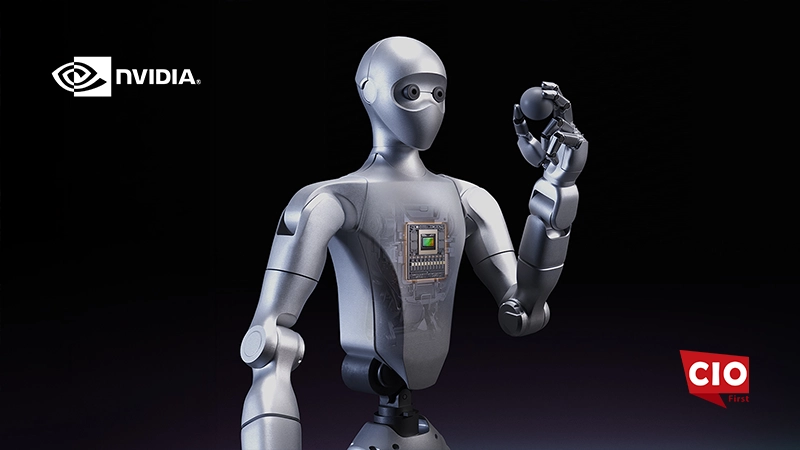
NVIDIA announced the NVIDIA Isaac™ GR00T Reference Humanoid Robot, the first open humanoid robot reference design built on NVIDIA Jetson Thor™ and the NVIDIA Isaac GR00T open development platform.
The reference design helps democratize frontier humanoid robotics research by providing access to advanced hardware and an open software stack without requiring proprietary platforms.
As demand for general-purpose humanoids accelerates, researchers still face a fragmented process spanning hardware integration, data collection, simulation, training, evaluation and deployment.
The NVIDIA Isaac GR00T Reference Humanoid Robot unifies development by bringing a Unitree H2 Plus humanoid robot and Sharpa Wave tactile five-finger hands (the “body”), with NVIDIA Jetson Thor-powered onboard compute and Isaac GR00T software and workflows (the “brain”) into a single integrated reference design, helping research teams move faster from robot bring-up to skill development and real-world validation.
With NVIDIA’s compute and open software stack at the center, the reference design gives research teams a more unified, secure foundation for advancing humanoid robotics.
Also Read: Ventiva Partners with ASUS to Explore Next-Generation Thermal Architectures for Compact AI Computing Systems
“Humanoid robots will bring physical AI to the world’s largest industries, opening a multitrillion-dollar economic opportunity,” said Jensen Huang, founder and CEO of NVIDIA. “The NVIDIA Isaac GR00T Reference Humanoid Robot gives researchers a single, open platform to make breakthrough discoveries toward general-purpose physical intelligence.”
A State-of-the-Art Humanoid Robot for Physical AI Development
The NVIDIA Isaac GR00T Reference Humanoid Robot is a state-of-the-art platform that brings the key building blocks for frontier humanoid research into one system, pairing a human-scale robot body with dexterous manipulation, sensing, control and onboard AI compute.
The reference design features:
- Unitree H2 humanoid chassis, standing nearly 6 feet tall and weighing 150 pounds, with 31 degrees of freedom across the body for human-scale testing.
- Dual Sharpa Wave tactile five-finger hands, enabling dexterous manipulation with 22 degrees of freedom and bringing the robot to 75 degrees of freedom across the body and hands.
- Multi-view sensing, including a head-mounted stereo camera with wide field of view (140 degrees horizontal, 102 degrees vertical), wrist cameras for close-range manipulation and an inertia measurement unit for motion tracking.
- Whole-body control, with arm torque of up to 120 Newton-meters, leg torque of up to 360 Newton-meters, a rated arm payload of 7 kilograms and peak payload of 15 kilograms, unlocking more capable lifting and reach.
- NVIDIA Jetson AGX Thor™ T5000 onboard compute, featuring an NVIDIA Blackwell GPU with 2,070 FP4 teraflops of AI performance, a 14-core Arm CPU, 128GB of unified memory and a configurable 40- to 130-watt power range for real-time sensor processing and robot inference.
- Connectivity across Ethernet, Wi-Fi 6, Bluetooth 5.2, USB and an array of microphones and speakers for voice interaction.
- Battery for extended operation, with a 15Ah, 0.972kWh capacity and about three hours of life.
- On-remote emergency stop function for quickly disengaging the robot safely.
NVIDIA Isaac GR00T Provides a Full-Stack Platform for Humanoid Development
The NVIDIA software stack provides the development environment for simulation, training, evaluation and deployment, while researchers retain control of their robot data, training data, telemetry and logs.
SOURCE: NVIDIA