
Welcome to CIOFirst’s Weekly Roundup — your trusted source for the latest breakthroughs shaping enterprise AI innovation, IT modernization, next-gen data architectures, and intelligent automation. This week’s highlights dive into agentic AI for IT operations, strategic acquisitions strengthening enterprise AI stacks, accelerated data engineering modernization, multimodal productivity integrations, and the next frontier of search, retrieval, and professional AI performance.
In IT Operations & Endpoint Management…
NinjaOne Introduces Native Remote Access to Streamline Endpoint Management
NinjaOne launches Native Remote Access, a built-in capability enabling IT teams to troubleshoot endpoints securely without relying on third-party tools. The feature enhances technician speed, reduces context switching, and delivers unified endpoint visibility within a single console — strengthening operational efficiency for global IT teams.
In Enterprise Data & AI Platforms…
IBM to Acquire Confluent to Build Smart Data Platform for Enterprise AI
IBM announces its intention to acquire Confluent in a landmark move aimed at building a next-generation intelligent data platform for enterprise AI. By integrating Confluent’s real-time data streaming with IBM’s AI and hybrid cloud ecosystem, the combined capabilities will help organizations power AI-driven decision-making at scale.
In Data Engineering & Cloud Modernization…
Databricks Unveils GenAI Partner Accelerators to Fast-Track Data Engineering and Migration
Databricks launches GenAI Partner Accelerators designed to speed up enterprise data engineering, cloud migration, and AI transformation initiatives. The accelerators provide pre-built patterns, best-practice architectures, and partner-led expertise to help enterprises modernize their data landscape with greater speed and reliability.
In Enterprise AI Adoption…
Accenture and Anthropic Expand Partnership to Accelerate Enterprise AI Adoption
Accenture deepens its collaboration with Anthropic to help enterprises safely scale generative AI adoption. The partnership enhances enterprise-grade deployment frameworks, brings industry-specific Claude-powered solutions, and supports responsible AI transformation spanning operations, customer experience, and product innovation.
In ERP Transformation…
Rimini Street Unveils Rimini Agentic UX to Bring Agentic AI to ERP Processes
Rimini Street introduces Rimini Agentic UX, a new AI-driven experience layer that automates ERP workflows through intelligent agents. The platform streamlines high-volume business processes, reduces ERP complexity, and enables organizations to unlock modernization without undertaking full-scale system replacements.
In AI Productivity & Workplace Applications…
Adobe Brings Photoshop Express and Acrobat to ChatGPT
Adobe expands creative and document productivity by integrating Photoshop Express and Acrobat directly into ChatGPT. The integration allows users to generate and edit images, manipulate documents, and execute workflows instantly — marking a significant step forward for multimodal enterprise productivity tools.
In Enterprise Search & Retrieval…
Cohere Unveils Rerank4, a More Powerful Search and Retrieval Model for Enterprise AI
Cohere launches Rerank4, its most advanced retrieval model to date, delivering major improvements in ranking accuracy, contextual search, and domain-specific relevance. The model boosts enterprise search performance, strengthens RAG pipelines, and improves agentic system reliability at scale.
In Advanced AI Models & Enterprise Readiness…
OpenAI Rolls Out GPT-5.2, a Breakthrough Point for Enterprise AI and Professional Tasks
OpenAI introduces GPT-5.2, a next-generation model delivering stronger reasoning, synthetic data generation, advanced search integration, and enhanced memory. The release marks a major leap forward in enterprise-grade AI, enabling richer professional workflows and more trusted autonomous systems.
⭐ Article of the Week
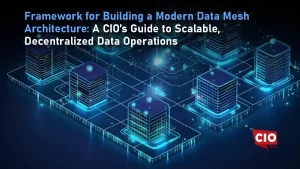
This in-depth guide explores how data mesh architecture empowers CIOs to scale decentralized data ownership, improve data discoverability, and build high-trust operational environments. The framework outlines best practices for governance, federated architecture, and cross-domain collaboration.