
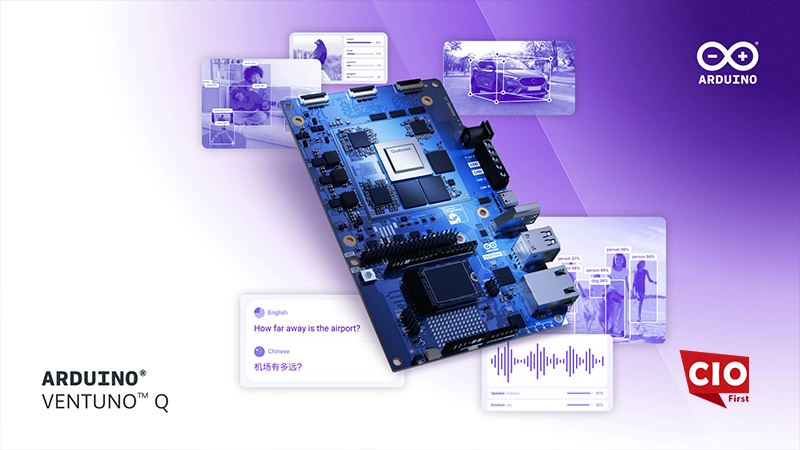
Qualcomm and Arduino announced the collaboration, board computer named Arduino VENTUNO Q that intends to offer support for future, generation artificial intelligence computing and internet of things applications. The platform merges the most recent Qualcomm dragon wing IQ8 chip with the Arduino system to give developers the ability to do high, performance computing for artificial intelligence on devices instead of depending on cloud computing.
This introduction is a substantial step forward in the evolving convergence of IoT and artificial intelligence. It gives developers, companies, and scholars a robust tool for making intelligent machines that perceive, think, and respond to their surroundings instantly.
A Powerful Edge-AI Platform
The Arduino VENTUNO Q runs on this Qualcomm Dragonwing IQ8 series processor. It packs in a CPU and GPU along with a special neural processing unit for AI tasks. That NPU can handle up to 40 trillion operations per second, which is a lot for running AI workloads I guess.
Then theres the STM32H5 microcontroller thrown in there too. Its meant for handling real time stuff like motors and sensors, keeping everything under control without delays. Developers talk about this setup as a dual brain kind of thing. One part focuses on the AI reasoning side, while the other deals with the hardware precision. It seems like that makes sense for what the board needs to do, though im not totally sure how seamless it all works together yet.
The platform also offers strong hardware capabilities:
16 GB LPDDR5 RAM for running complex AI models and multitasking
64 GB onboard storage, expandable through additional interfaces
Wi-Fi 6 and Bluetooth 5.3 connectivity for the latest IoT networking protocols
Camera support, sensor support, robotics support, and industrial I/O support
Support for popular Linux distributions like Ubuntu and Debian for AI development
These features enable the system to run AI locally at the edge. This means that the devices can be used for various applications like computer vision, speech recognition, and robotics without the need for cloud connectivity.
Designed for Physical AI and Smart Devices
One of the main goals of the VENTUNO Q is to enable what developers call “physical AI”-systems that can interact with the real world through sensors, cameras, and mechanical components.
Examples of applications supported by the platform include:
Autonomous robots capable of navigating and interacting with environments
Smart industrial inspection systems that use computer vision
Voice-controlled IoT devices and assistants
Smart home devices with advanced sensing capabilities
Robotics platforms for education, research, and manufacturing
By integrating real, time control and AI processing on a single board, the system totally dispensed with several devices or even complex hardware architectures. This sort of solution not only cuts down on latency but also makes edge AI project development easier.
Also Read: IBM and University Researchers Create an Exotic Nature with Quantum Computing
Besides, with the Arduino App Lab, developers can make Python, based applications that are AI, powered simply by combining modular services like vision recognition, networking, and sensor analytics.
Implications for the IoT Industry
The release of the Arduino VENTUNO Q signals a significant change in the Internet of Things (IoT) market from simple connected devices to smart systems that make decisions independently locally.
In the past, the majority of IoT devices relied on the cloud processing method to analyze sensor information and generate responses. However, the method is normally characterized by issues such as latency, bandwidth costs, and security problems. The devices that utilize the edge AI platform, such as the VENTUNO Q, can carry out processing tasks locally, which minimizes the dependency on the cloud infrastructure.
For IoT developers and businesses, this shift offers several advantages:
Faster Response Times
With real-time AI, devices can process information in an instant in response to their environment, making it perfect for robotics, smart machines, and industrial monitoring.
Improved Data Privacy
With Edge AI, the amount of data sent to cloud servers is reduced, ensuring better security.
Lower Operating Costs
With Edge AI, the cost of cloud computing is significantly reduced, making the Internet of Things a reality.
Greater System Reliability
With Edge AI, systems can function independently of cloud connections, making them reliable.
Impact on the AI Industry
The new platform represents the AI industry’s move toward edge computing instead of being fully in the cloud.
As AI models become more effective and require less power, various companies have started to install these AI applications directly into their hardware rather than only depending on large centralized data centers.
Such development will likely prompt significant breakthroughs in industries such as:
With the incorporation of AI computation and remote hardware control, the VENTUNO Q platform presents innovative intelligent and interactive machines that are capable of both interpreting the data and performing the relevant action instantaneously.
Business Opportunities Across IoT and AI Ecosystems
The launch of Arduino VENTUNO Q could be a major game changer for companies in the IoT and AI sectors.
Manufacturers of hardware might leverage the platform to boost their speed in creating smart gadgets and robotic technologies.
Programmers can design AI software that is specifically tuned for edge computing.
Organizations setting up IoT networkslike factories, warehouses, and smart citiescould reap the advantages of quicker and more efficient smart systems.
Furthermore, the collaboration between Qualcomm and Arduino signifies a more general plan of merging state, of, the, art semiconductor technology with open developer communities. Qualcomms takeover of Arduino back in 2025 was part of bringing its cutting, edge AI processors to Arduinos global family of developers and creators.
The Future of IoT and AI Integration
The Arduino VENTUNO Q is an example of how AI and IoT are merging to develop intelligent physical systems with sensing, reasoning, and autonomous acting capabilities.
As edge AI hardware improves in capability and accessibility, it will provide businesses and developers with opportunities to create sophisticated applications without the need for costly infrastructure and hardware architecture.
For industries like robotics and infrastructure, the platform is a step towards a future where intelligent systems will work seamlessly at the edge, bringing AI closer to the physical world and unlocking possibilities for the IoT and AI ecosystem.