
The global high-performance enterprise computing landscape is undergoing a structural paradigm shift. For decades, mission-critical infrastructure-such as core banking ledgers, national healthcare databases, air traffic control centers, and high-volume transaction processing systems-relied almost exclusively on dedicated mainframe architectures. Built on IBM’s specialized z/Architecture instruction set, these systems offered unmatched uptime, hardware-level encryption, and transaction isolation.
But, as enterprise IT organizations rapidly adopt artificial intelligence, cloud-native microservices, and edge-specific applications, software development today has progressively become centered on Arm-native systems.
There are over 22 million software developers across the world, and the Arm software platform supports the majority of cloud, mobile, and artificial intelligence development frameworks used today. But, the challenge of bridging legacy mainframe data with Arm-native applications posed a significant architectural limitation in data mobility and translation.
Moving sensitive enterprise data out of secure mainframe environments into external Arm-based cloud clusters created latency, increased network egress costs, and introduced security vulnerabilities during data transit.
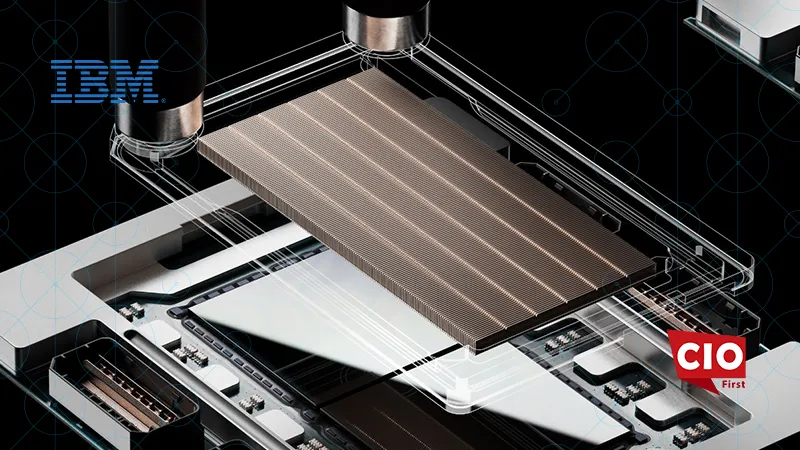
Bridging this architectural divide, technology pioneer IBM announced the annual Hot Chips conference, the industry’s first dual-architecture mainframe processor. Engineered on a cutting-edge 2-nanometer (2nm) technology node, the next-generation chip allows future IBM Z and LinuxONE systems to execute both IBM z/Architecture and Arm® instruction sets natively within the same processor silicon.
Native Dual-ISA Execution on 2nm Silicon
The dual-architecture processor is a result of the strategic partnership between IBM and Arm that was established in April 2026. In contrast to previous attempts to use either clusters of Arm cores or software-based emulation of instructions, all of the cores on the new chip are designed to perform both Arm and IBM Z (or LinuxONE) instructions, making it possible to run Arm64 Linux applications on the same processor alongside z/OS and Linux-on-Z applications.
Technical details and characteristics of the processor include:
Advanced 2 nm Lithography Technology: The processor is based on a 2-nanometer lithographic technology and features 11 cores working at clock speeds above 5.7 GHz.
Hardware AI Accelerator: The new processor features dedicated in-chip AI inference accelerators specifically developed for instant in-transaction fraud detection and evaluation of credit card transactions in milliseconds.
Data Processing Unit: A special DPU is incorporated into the processor to accelerate I/O processes along with an advanced multi-tiered cache system to avoid memory bottleneck.
Switching Between ISAs in Nanoseconds: Hypervisor-level (KVM) switching is used to switch between Arm64 and z/Architecture applications in nanoseconds without any drop in performance and isolation issues.
“As organizations modernize their application portfolios and integrate AI into core business operations, they need infrastructure that expands their options,” said Christian Jacobi, Chief Technology Officer and IBM Fellow, IBM Systems Development. “This processor represents a significant architectural advancement for IBM Z and LinuxONE. By bringing Arm natively to our platform, we’re combining access to one of the industry’s fastest-growing software ecosystems with the qualities that have made IBM systems the foundation for how businesses run today.”
Also Read: Beyond Copilots: How Progress Software’s Agent-Ready UI Release Signals a Turning Point for Software Engineering
Mohamed Awad, Executive Vice President, Cloud AI at Arm, added: “As AI scales, more of the computing landscape is converging on Arm. Bringing Arm compute and its software ecosystem to IBM Z and LinuxONE will extend that momentum into mission-critical enterprise infrastructure.”
Impact on the Computing Industry
The announcement of IBM’s dual-architecture processor signals fundamental structural developments across the broader Computing landscape:
1. Dismantling the Barrier Between Legacy Mainframes and Cloud-Native Silicon
Historically, enterprise IT divisions operated in silos: core mainframe teams managed transactional databases while cloud teams built modern AI microservices on x86 or Arm instances.
Unveiling a unified, dual-ISA chip accelerates Unified Hybrid Compute Architectures. Data center architects can now run modern Arm-native AI agents and containerized software directly on the same physical hardware that hosts core enterprise databases, eliminating data translation layers.
2. Establishing Arm as a Universal Enterprise ISA
While Arm originally dominated low-power mobile devices, its recent expansion into hyperscale cloud data centers (such as AWS Graviton and Microsoft Cobalt) proved its server-grade efficiency.
IBM’s decision to embed Arm natively into its flagship mainframes confirms Arm’s transition into a universal enterprise instruction set architecture, capable of running alongside traditional mainframes in the world’s most heavily regulated environments.
Overall Effects on Businesses Operating in the Sector
For financial institutions, government agencies, global telecommunications operators, and enterprise IT leaders, IBM’s technological milestone provides direct operational advantages:
Key commercial benefits across the enterprise sector include:
Speed Up AI Application Deployment: Programmers are able to implement Arm-based AI frameworks and state-of-the-art cloud-native technologies without modifications to existing mainframe data repositories.
Avoiding Data Transfer Overhead and Network Latency: Performing calculations on the chip where the transaction log is held will avoid the data transfer outside the mainframe, greatly reducing network overhead and cloud transfer costs.
Mitigating Modernization Risk for Financial Institutions: Banks and Insurance companies will be able to incrementally modernize their IT stack while ensuring z/OS level of safety and compliance.
Conclusion
The launch of the world’s first dual-architecture mainframe processor represents an important milestone for the development of enterprise computer systems. Combining state-of-the-art silicon technology, on-chip AI capability and support for Arm natively along with the reliability of the IBM Z and LinuxONE lines, IBM offers an extremely versatile platform to build the future of the hybrid enterprise. For the computer industry at large, this groundbreaking step shows that the future of enterprise AI requires the use of flexible platforms bridging mission-critical reliability and modern open-source capabilities.