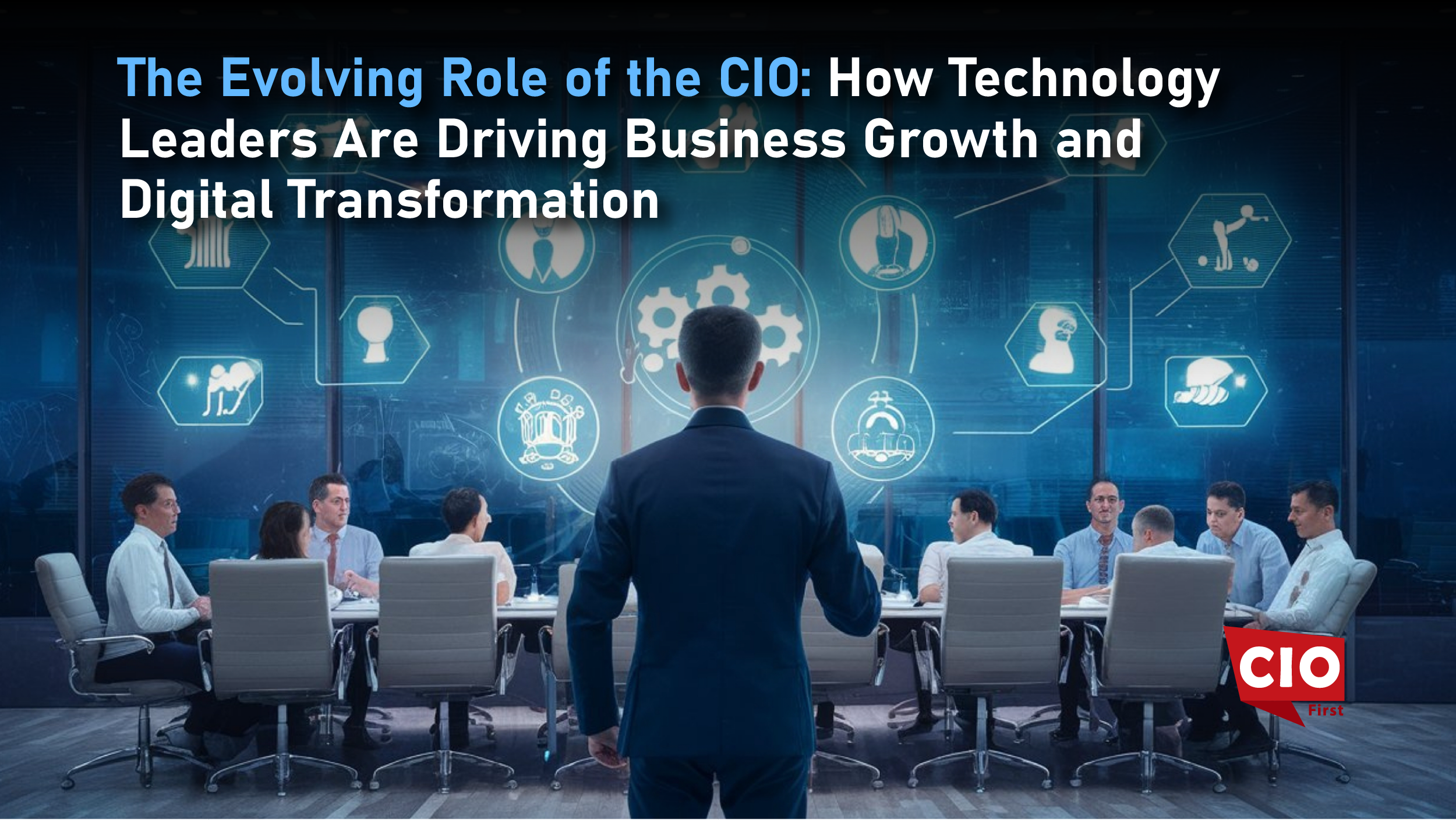
Technology has a habit of changing job descriptions before companies realize they need to change them. The CIO is a good example. A role once associated mainly with infrastructure, IT budgets, systems uptime, and keeping employees connected now sits much closer to the questions that determine whether a business grows or falls behind.
This shift hasn’t occurred because CIOs had a great desire for more seats at the executive table. The reason this has occur is because the business itself has come to depend on technology for all things material. There isn’t anything that isn’t run by technology anymore-whether that’s customer experience, the product development cycle, data, security or the business operations (or most things AI) these days. Therefore, the role of CIO has and will become much more strategic in that the question isn’t just whether IT is running well, but whether the business is able to accomplished X (using technology differently).
The Paradigm Shift from IT Custodian to Business Strategist
There was a time when a good CIO could have a fairly simple scorecard. Keep the systems running. Control costs. Replace aging infrastructure before it becomes a problem. Make sure employees can access the tools they need. Deal with security incidents when they appear. It was important work, but much of it happened away from the center of the business.
That distance is becoming difficult to maintain.
A retailer cannot separate technology from its customer experience when ordering, payments, recommendations, inventory, and loyalty all depend on digital systems. A manufacturer cannot discuss operational efficiency without discussing data and automation. A financial company cannot think about growth without thinking about cybersecurity and digital trust. Technology has moved into the operating model itself.
That explains why the modern role of the CIO looks less like technology maintenance and more like business transformation. IBM’s 2026 Tech Leader Study found that 80% of CIOs and CTOs say their transformation mandates come directly from the CEO. That is a significant change in expectation. The CIO is not simply being asked to deliver a system that someone else has already decided the business needs. The technology leader is increasingly involved in turning the CEO’s strategic ambition into something the organization can actually execute.
There is another important shift underneath this. CIOs now have to understand the commercial consequences of technology decisions. A faster platform matters because it can shorten a product launch. Better data matters because it can improve decisions. A stronger digital experience matters because customers notice when competitors make things easier.
In other words, the role of the CIO has moved closer to the question every business eventually has to answer. What are we trying to achieve, and can our technology help us get there?
The Four Strategic Pillars of the Modern CIO
Spearheading AI and Digital Transformation

AI has made the CIO’s changing role much more visible, but it has also created a dangerous temptation. Companies can spend too much time asking which AI tool they should buy and too little time asking what work should actually change.
That distinction matters.
Generative AI becomes useful when it is connected to real workflows, trusted data, existing systems, and clear business objectives. Otherwise, an organization can end up with dozens of impressive experiments and very little operational change. The CIO has to see the whole chain. Legacy systems may need modernization. Data may need to move out of disconnected silos. Cloud infrastructure may need to become more flexible. Employees may need new ways to work with AI.
This makes digital transformation less about replacing old technology and more about removing the friction that old technology creates.
The CIO also has to resist the pressure to transform everything at once. Not every process needs AI. Not every application needs to move to the cloud tomorrow. Good technology leadership involves deciding where change will create an advantage and where stability is still the better choice. That judgement is becoming as important as technical knowledge itself.
Transitioning from Cost Center to Revenue Generator
Historically technology has been seen as something which business must finance. As tech actually resides within customer journey this is becoming increasingly difficult to justify. If business offers a digital product, tech team are providing, not just, infrastructure for another business function but in fact the product itself. So too if tech improves search, personalization, payment, response, to product development speed for anything, really.
This changes the conversation around technology budgets.
Also Read: Strategic Value of IT Asset Management (ITAM): How CIOs Optimize Costs, Reduce Risk, and Drive Business Value
The useful question is no longer only whether a project stays within budget. It is whether the investment improves an outcome that matters to the business. That could mean more customers, higher retention, faster product launches, lower operating friction, or a better experience.
The strongest CIOs understand this connection. They can sit with a product leader and discuss customer behavior, with a finance leader and discuss investment returns, and with an engineering team and discuss architecture. That ability to move between business language and technical language is becoming a competitive advantage.
Technology does not automatically become a revenue generator just because a CIO calls it one. The commercial outcome still has to be designed into the initiative from the beginning.
Championing Cybersecurity and Risk Management
There is a natural tension between speed and control. Businesses want to experiment with AI, connect more systems, move data faster, and give teams access to new tools. Security teams, quite reasonably, want to know what those tools can access, where information is going, and who is accountable when something goes wrong.
The modern CIO has to sit in the middle of that tension.
That means cybersecurity cannot remain a final approval step before a new technology goes live. Data governance, identity controls, zero-trust principles, compliance requirements, and risk assessments need to be considered while the technology is being designed.
This is especially critical as we see AI spread out of technology and into other departments. Individuals can embrace new application uses, business units can experiment themselves, and varying elements within an organization can begin to automate business workflows using technology solutions. A CIO focused only on central IT would fail to see many things as they occur in the larger organization.
The answer is not to slow everything down. It is to create sensible boundaries within which people can move quickly. Good governance should make responsible innovation easier, not make innovation impossible.
Cultivating a Data-Driven Culture and Talent
Technology transformation eventually runs into the same obstacle that many transformation programme have faced for decades. People.
A company can invest in fancy platform but still not gain much if people cannot use it, manager do not approve the change or business team continue to operate under process of the old model.
This makes the idea of ‘Bilingual CIO’ extremely valuable. A CIO must understand architecture, data, AI, security and infrastructure. At the same time, a CIO must understand customers, revenues, business operations and business risk. But the CIO cannot be the only person who speaks both languages.
IBM’s 2026 CEO Study found that 85% of CEOs say all functional leaders must become technology experts in their domain. That points to a much bigger change in the organization. Marketing leaders need to understand the technology behind customer data. Operations leaders need to understand automation. Finance leaders need to understand the economics of technology investment.
Microsoft’s 2026 research reinforces the people side of this shift. Organizational factors such as culture, manager support, and talent practices accounted for 67% of reported AI impact, compared with 32% for individual mindset and behavior. Microsoft notes that this is an association rather than proof of causation. Still, the implication is hard to ignore. Giving people access to AI is one thing. Creating the conditions in which they can use it effectively is another.
That makes talent development part of the technology agenda, not a separate HR exercise.
Measuring Success and How Today’s CIOs Demonstrate ROI

This is where the modern CIO faces perhaps the most uncomfortable question. What did all that technology investment actually accomplish?
Traditional IT measures still have their place. Nobody wants unreliable systems or unresolved technical issues. But uptime alone does not tell a CEO whether technology helped the company acquire customers, launch products faster, improve service, or make better decisions.
The measurement framework has to move with the role.
A CIO may need to look at digital revenue, customer acquisition costs, time-to-market, productivity, customer experience, operational efficiency, and risk alongside conventional IT metrics. The exact measures will depend on the business. What matters is that technology performance is connected to business performance.
AI makes this even more important. AWS research conducted with Harvard Business Review Analytic Services found that nearly three-quarters of organizations lack a clear measure of value from agentic AI.
That is a warning sign. Businesses are moving quickly into a technology that can affect entire workflows, yet many still struggle to define what success should look like.
A sensible CIO therefore starts with the outcome, not the tool. What problem are we solving? What changes if the project succeeds? How will we know? And what happens if the expected value does not appear?
Those questions may sound basic. They are not. They are what separate technology spending from technology strategy.
The Future of IT Leadership
The next few years will make the CIO’s job even less predictable. The technology landscape is moving faster than the organizational structures built to manage it.
Google Cloud’s 2026 AI Agent Trends research describes a shift away from simple prompts and isolated AI tasks toward agents that can orchestrate complex, end-to-end workflows with greater autonomy. That matters because the unit of change is getting bigger. AI is no longer only helping someone complete a task. It can increasingly participate in the process itself.
For CIOs, that creates difficult decisions around data access, accountability, security, human oversight, and process design. It also opens the door to deeper automation across functions that previously depended heavily on manual coordination.
The CIO of the near future will therefore need to think beyond systems and applications. The bigger question will be how technology should shape the way the organization works. That requires technical judgement, commercial understanding, and a willingness to challenge assumptions that worked perfectly well in the previous era.
Conclusion
The role of the CIO has expanded because technology has stopped being something businesses simply use. It has become part of how they compete.
That does not mean every CIO automatically becomes a business strategist. A larger technology budget or a place in an executive meeting proves very little on its own. The real test is whether the CIO can connect technology decisions to outcomes the business cares about, while still protecting the organization from the risks that come with moving faster.
That’s the scope and the anxiety in today’s job. It’s true that CIOs has never gained a higher position than the one right now, but it means that CIOs has also not had more reason to say ‘My tech can’t provide more value.’ Companies would better examine this condition and think how business is influenced by the IT management: does the company itself being led or, is it just running smoothly at all cost?