
Small changes in enterprise systems can grow quickly. Add one customer feature and suddenly multiple teams need to adjust. That may touch the apps, the data stores, the links between systems, and the permission checks. Before long, it is no longer a simple task. It becomes a bigger program with many moving parts.
After that, it makes sense. Teams spend more hours on setup and on the platform rules. They have less time for the real business results.
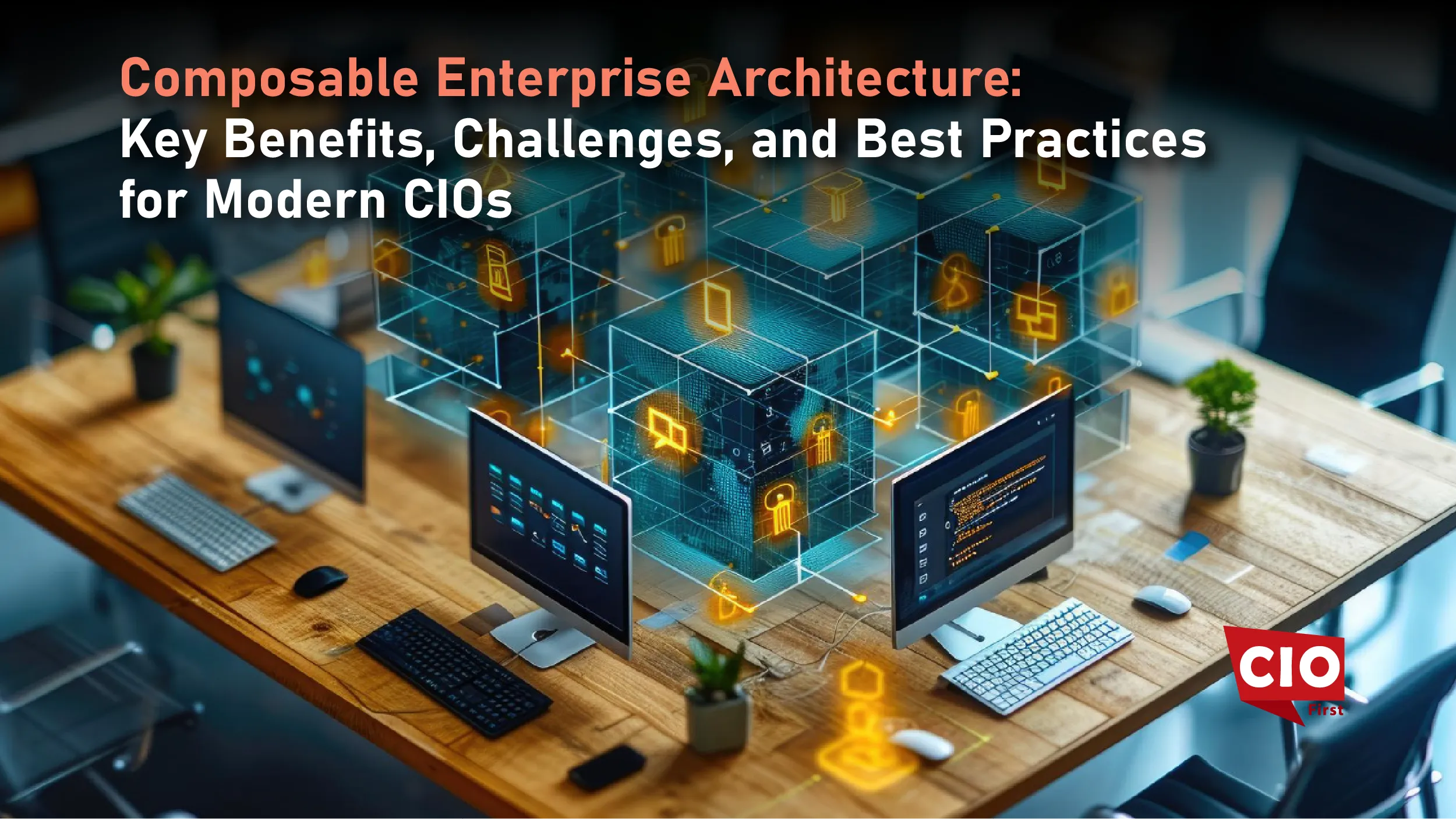
Composable enterprise architecture is a way to split large IT systems into smaller parts. These parts map to business capabilities. Each part can be used again in other places. It can also be swapped out when the business changes.
In this model, the IT landscape is not one big linked unit. It is more like a set of building blocks. The blocks can fit together when you need them, but they do not have to stay joined forever.
That distinction is important. This is not simply another way to modernize legacy applications. It changes how technology teams build, govern, and support the business. Done well, composability gives CIOs more room to respond when customer expectations, operating models, or AI capabilities change.
Decoding Composability and Its Building Blocks

The idea becomes easier to understand once we separate a business capability from a technical service.
A Packaged Business Capability, or PBC, is a self-contained technology capability built around a specific business outcome. Payment processing is one example. Order fulfillment is another. Customer identity, inventory management, and pricing can also be treated as individual capabilities.
A micro service can sit underneath one of these capabilities, but the two ideas are not identical. A microservices is mainly a technical unit. A PBC is defined by what the business needs to accomplish.
Microsoft describes microservices as small, autonomous services that can be deployed and scaled independently. At the same time, Microsoft points out that microservices bring challenges involving service discovery, data consistency, and distributed-system management. That is the catch many architecture discussions skip. Splitting an application does not automatically make it simple.
Composable enterprise architecture takes modularity and connects it more directly to business change.
Four principles sit at the center of the model.
Modularity means a capability can be separated and reused without rebuilding everything around it.
Autonomy means a capability can evolve with limited mpact on other parts of the enterprise.
Orchestration brings separate capabilities together to complete a larger process. A digital order, for instance, may involve identity, payment, inventory, fulfillment, and customer service.
Discovery makes those capabilities visible. A useful component that nobody knows exists will eventually be rebuilt by another team.
| Dimension | Monolithic | Microservices | Composable PBC-based |
| Scope | Entire application | Technical service | Business capability |
| Governance | Centralized | Distributed | Shared IT and business |
| Flexibility | Limited | High | High at capability level |
| Business ownership | Mostly IT | Mostly IT | Business and IT |
That last column is the real point. Composable enterprise architecture is not about having more pieces. It is about making those pieces useful to the business.
Key Business and Technical Benefits for the Enterprise
One clear advantage is speed. Teams that already have useful tools can keep working instead of starting from nothing each time. With this approach, a new online service can bring together parts like sign in, payments, customer data, stock, and delivery. Then the work can focus on the parts that are truly new.
That can shorten the path from an idea to something customers can actually use. It also reduces the temptation to create another isolated application every time a business unit needs something different.
There is a second benefit that is less obvious but arguably more important. Modular systems give enterprises more options when something needs to change.
A capability that is outdated can be replaced without necessarily forcing a complete redesign of the surrounding system. A heavily used service can be scaled independently. A new implementation can be tested without treating the whole technology estate as one indivisible unit.
Also Read: Business Value of IT Metrics: How CIOs Measure Technology’s Impact on Enterprise Growth
This is where composable enterprise architecture starts to matter for AI.
IBM’s current webMethods Hybrid Integration material describes composable business architecture around curated, contextual assets, APIs, and events. It also says existing APIs and integration flows can be reused to give AI agents access to enterprise data and functionality.
That is a useful shift in thinking. An AI agent does not always need a completely new system built around it. It can potentially use capabilities the enterprise already has, provided those capabilities are exposed through suitable interfaces and governed properly.
The same logic applies to future applications. CIOs cannot know which tools, platforms, or AI systems will become important next. They can, however, make the underlying business capabilities easier to connect and replace.
That is the real promise of composable enterprise architecture. It creates optionality. Technology does not become future-proof, but the organization becomes better prepared for change.
The CIO’s Dilemma and the Integration Challenges
There is a catch, and it is a big one.
More components do not mean less complexity. They often move complexity somewhere else.
AWS notes that reusable components can reduce duplicated work, but chaining components creates operational challenges around dependencies and versioning. A component may work perfectly on its own and still create problems when several other services depend on a particular version of it.
This is where API sprawl starts to hurt.
As more capabilities are exposed through APIs, the enterprise has more interfaces to document, secure, monitor, update, and retire. Different teams may create different versions of similar services. Ownership can become unclear. One API may follow strong security practices while another quietly becomes a weak point.
The architecture still looks modular. The operating model, however, starts to look messy.
Data is another pressure point. Independent capabilities may have their own data stores and ownership rules. That can support autonomy, but business transactions rarely respect neat architectural boundaries. An order, payment, inventory record, and fulfillment status still need to tell a consistent story.
Then comes the human side.
Composable enterprise architecture asks business and technology teams to work differently. Product managers, engineers, security teams, data teams, and operations cannot operate as isolated departments when business capabilities cross all of those boundaries.
That is where the idea of fusion teams becomes useful. People need to work around business outcomes rather than simply handing requirements from one department to another.
The uncomfortable truth is that technology is often easier to modularize than an organization. An enterprise can separate applications relatively quickly. Separating ownership, budgets, procurement processes, incentives, and decision rights is much harder.
So the biggest danger is not modularity.
It is modularity without ownership.
Strategic Best Practices for Composable Governance

The first requirement is simple but often ignored. People need to know what already exists.
A centralized component catalog or enterprise service registry can give teams one place to discover available PBCs, APIs, services, owners, dependencies, and usage rules. Without that visibility, reuse becomes a matter of luck. Teams will keep building capabilities they could have reused because they never knew the existing asset was there.
Governance also needs to move closer to the architecture itself.
API gateways, identity controls, zero-trust policies, monitoring, and automated compliance checks should not be treated as paperwork that happens after development. They should be part of the standard way components are exposed and consumed.
Platform engineering can make this practical. Instead of asking every development team to solve the same infrastructure and governance problems independently, an internal platform can provide approved patterns, tools, and self-service capabilities. Developers get room to move, while the organization keeps control over the things that matter.
The migration approach deserves equal attention.
Microsoft’s June 2026 assessment recommends evaluating areas such as independent deployability, data ownership, communication patterns, and observability before moving toward microservices. It also recommends beginning with edge services that have fewer dependencies rather than trying to break apart the entire monolith at once.
That is a sensible principle for composable enterprise architecture too.
A CIO does not need to make the whole enterprise modular in one program. That sounds ambitious in a strategy presentation. In practice, it can become an expensive exercise in moving risk around.
A better starting point is a high-value business journey. Pick a customer-facing process or business capability where faster change has a clear payoff. Understand its dependencies. Establish ownership. Put governance around it. Then measure what improved.
If the model works, expand it.
The goal is not to create the most modular architecture possible. The goal is to create an architecture that can change without losing control.
Conclusion and Actionable CIO Checklist
Composable enterprise architecture will not solve every legacy technology problem. Nor should CIOs treat it as the next grand architecture rewrite.
The better question is more practical. Can the organization introduce change, replace capabilities, and connect new technology without repeatedly disturbing the systems that keep the business running?
That question becomes harder as AI spreads across enterprise infrastructure. Google Cloud’s August 24, 2026 reporting says 79% of technology leaders cite security, governance, or operations as the biggest challenge to scaling inference.
That should change how CIOs think about composability. Speed matters, but speed without control simply creates a faster way to create technical debt.
A useful CIO checklist is straightforward. Know which capabilities matter. Give each one an owner. Make reusable assets discoverable. Govern interfaces from the start. Start with a focused business outcome rather than a giant rewrite.
The strongest composable enterprise architecture is not the one with the most components. It is the one that gives the business more freedom to change without turning technology into its next constraint.