
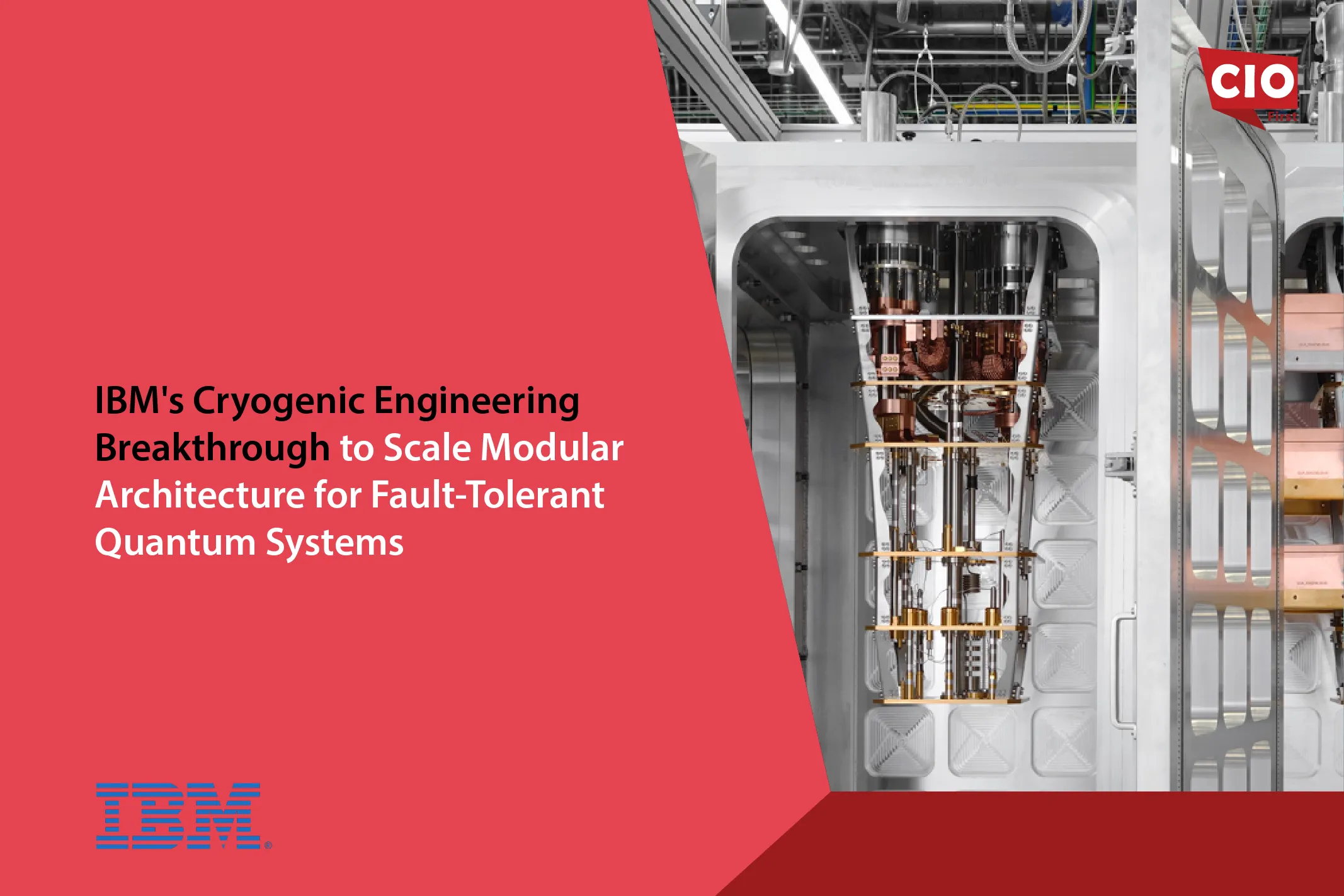
IBM has announced a major engineering milestone after successfully linking and cooling two distinct cryogenic modules within a unified environmental framework. The scalable architecture is engineered to build the modular, shared, ultra-cold infrastructure necessary to connect hundreds of quantum processors into high-density computing systems capable of executing complex enterprise workloads.
The technical achievement marks a pivotal step on IBM’s strategic roadmap toward deploying IBM Quantum Starling by 2029-targeted to become the industry’s first operational fault-tolerant quantum computer, integrating advancements across quantum processor design, system engineering, real-time error correction, and decoding capabilities.
Redefining Cryogenic Scale and Physical Footprint
Combined, the initial operational modules measure more than eight feet high and eight feet wide. During initial validation testing, the integrated system achieved a joint thermal cooldown to 4 Kelvin (the temperature of liquid helium) in under five days, before stabilizing at a final operational temperature below 15 millikelvin.
Each module’s enlarged vacuum chamber delivers up to 12 times the wiring volume compared to previous-generation IBM quantum installations, accommodating significantly higher densities of inter-chip and inter-module connectivity.
Also Read: IonQ Partners with CMC Microsystems to Supply Trapped-Ion Quantum Systems to Canada’s FABrIC Platform
The modular, box-shaped enclosure allows units to be arrayed side-by-side in continuous configurations. This design leverages the expanded internal footprint to directly link adjacent quantum chips using IBM’s proprietary “L-coupler” technology, which enables high-speed quantum state communication and resource sharing across discrete silicon dies.
Advancing the Quantum Technology Roadmap Toward Starling
IBM’s long-term quantum development plan targets using L-couplers to join multiple discrete processors into a unified computing framework housing at least 1,000 programmable logical qubits by 2027. To support this objective, IBM will begin installing its IBM Quantum Nighthawk processors inside the new cryogenic test environment later this year to conduct operational performance evaluations.
By the time the Starling platform reaches commercial deployment in 2029, IBM projects that each individual cryogenic module will house thousands of functional qubits. The architecture builds on Starling’s underlying error-correction protocols, which significantly reduce the physical hardware footprint required to achieve fault tolerance.
“Bringing fault-tolerant quantum computers to industries depends on several fundamental advances,” said Jay Gambetta, Director of IBM Research and IBM Fellow. “The successful connection and operation of these cryogenic modules signals a leap forward in that direction and will accelerate our progress alongside continued innovation in quantum hardware, software, and algorithms.”
Accelerated Component Testing and Rapid Iteration
Beyond expanding system capacity, the modular cryogenic environment streamlines hardware engineering processes. By decoupling core environmental systems-including key architectural elements adapted from the IBM Quantum System Two-engineers can isolate, test, and iterate individual subsystems independently without taking down the full operational environment.
This modular deployment demonstrates IBM’s systematic execution against its multi-year quantum computing roadmap, clearing a critical hardware bottleneck on the path toward fault-tolerant, commercial quantum scale.